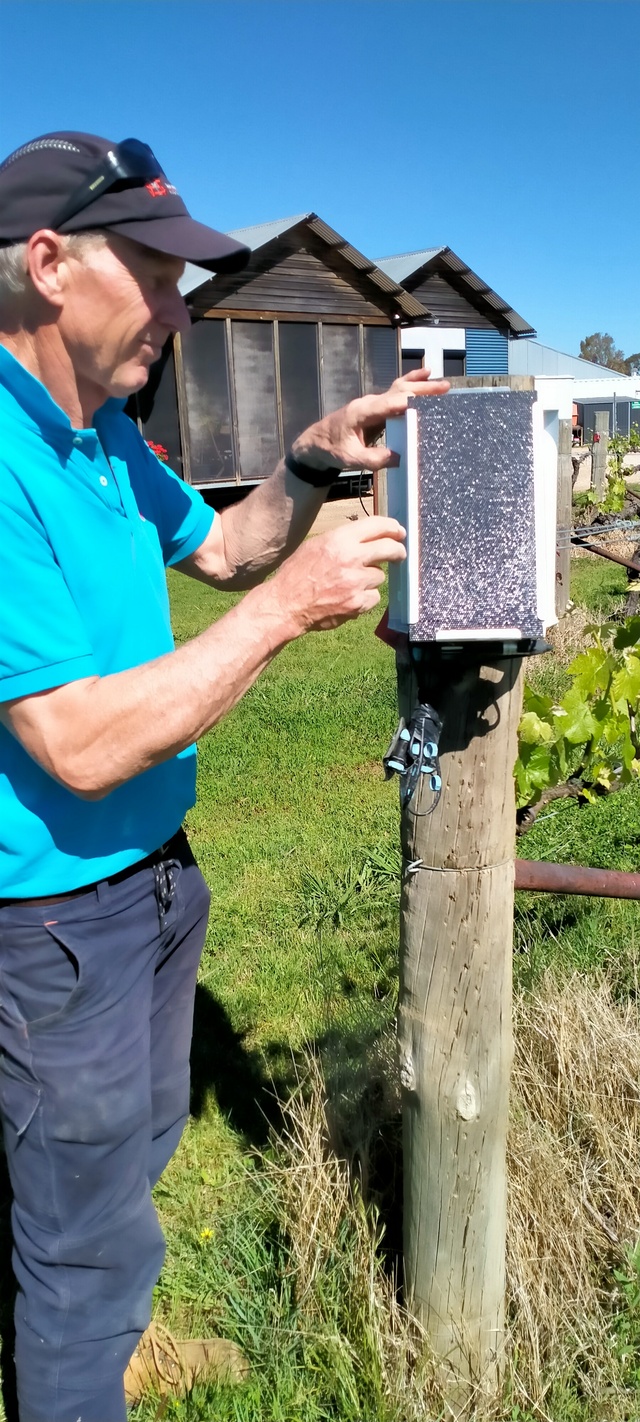
A smoke sensor, which has the potential to save hundreds of millions of dollars in lost wine production, developed by La Trobe University researchers after a close work with the wine industry in the Yarra Valley.
Wine Industry Smoke Detectors (WISDs) track smoke events like bushfires and burn-offs around vineyards and advise winegrowers whether it is likely to taint their grapes, and if they need to discard their season’s harvest, or use winemaking techniques to remove the taint.
Latrobe University research professor Ian Porter has led a great team researching ways to help the wine industry produce tools to understand and avoid crop loss to smoke taint in wine.
“We developed the idea (of the WISDs) because growers had no way of knowing if grapes were affected by taint during the growing season, and bushfires had no accurate and rapid way of determining whether their crops were tainted,” Prof Porter said.
“Diagnostic tests of grapes were often too late to make decisions and many crops were dropped due to uncertainty.
“The WISDs has really helped growers make decisions early and given more certainty about picking a crop.”
After trials of the sensor in vineyards across south-eastern Australia, the research team found smoke did not taint wine grapes as much as viticulturalists believed.
“Growers think that all smoke causes smoke taint, but data collected by our team has for the first time globally linked the amount of fresh smoke needed in vineyards to smoke taint in the bottle. This has been the Holy Grail of research that’s now being solved,” Prof Porter said.
“This sensor has the potential to save a heap of grapes they would usually throw away, which can be financially and emotionally devastating for winegrowers. It’s one of the reasons we developed the WISDs.”
The prototype smoke loggers have been developed by La Trobe University researchers and supported with funding from Wine Australia, La Trobe University and other partners, including the Victorian and Australian governments and regional wine associations.
A network of 100 prototype loggers was deployed in vineyards in north-east Victoria after the catastrophic bushfires in 2020, with the technology refined in the years that followed.
Prof Porter said the WISDs include a multifunctional low-cost logger which measures smoke particulate matter and converts the information into a traffic light risk prediction system for smoke taint in wine through sophisticated algorithms.
“A central server receives information about smoke from a vineyard and in real time sends the risk information back to a phone app and a website for the industry to make decisions about potential impacts of smoke on their grapes and wine,” he said.
“This is the first time globally that such a system exists.”
Australian agtech provider Goanna Ag has now signed on to commercialise the WISDs over the next two years, during which time the hardware and algorithm will be further validated in real-world fire events and the network of WISDs expanded to other wine regions across Australia.
Prof Porter said his team had worked closely with industry in the Yarra Valley for over a decade to help develop the information used to make the WISDs successful.
“They will benefit greatly from the use of the WISDs to be able to be certain about any smoke effects in the valley,” he said.
“The first commercial batch has been sold but future supplies will be available through Goanna Ag.”